

中华神经外科杂志(英文)
精选周刊 第16期
神外前沿讯,2021年6月中华神经外科杂志(英文)《Chinese Neurosurgical Journal》在线发表了首都医科大学附属北京朝阳医院介入科刘克云医师、首都医科大学附属北京天坛医院神经介入中心首席专家李佑祥等文章《Correlation of periodontal diseases with intracranial aneurysm formation: novel predictive indicators》。
牙周疾病与颅内动脉瘤发生的相关性分析:一项新的预警指标?
研究背景:
牙周炎是慢性细菌感染与宿主炎症反应之间复杂的病理反应。近年来,有研究表明在心血管动脉粥样硬化斑块上及腹主动脉瘤壁组织上均发现了牙周炎细菌DNA,然而,既往相关研究大多聚焦于主动脉以及心脏血管疾病等方面,在牙周炎与脑卒中之间的相关性研究较为罕见。Hallikainen等学者发现牙周炎和牙龈出血与动脉瘤性蛛网膜下腔出血的发生风险相关,变异链球菌引起的牙周炎症参与了脑卒中的发生。然而,牙周病与颅内动脉瘤发生发展的相关性尚无确切证据。因此,本研究首次提出牙周疾病与颅内动脉瘤的发生相关,并通过牙周疾病严重程度的角度提出预测颅内动脉瘤发生的风险分级系统,为预防颅内动脉瘤的发生以及促进多学科交叉诊疗的精准医疗新理念提供了依据。
研究方法:
入组281例患者,通过头部影像学检查来确定是否存在颅内动脉瘤并进行牙周健康状况检查。根据动脉瘤存在与否对入组患者进行了分组:动脉瘤组与非动脉瘤组。
研究结果:
经过统计学分析,两亚组在性别、糖尿病、高脂血症、脑血管病史(包括脑缺血、出血事件)、其他个人病史(如饮酒、吸烟、BMI)的分布差异等临床基线信息方面均无统计学差异。研究进一步采用逻辑回归分析发现颅内动脉瘤的发生与高龄、高血压以及严重的牙周炎或牙龈炎(牙周参数较高)呈正相关。
研究结论:
牙周炎或牙龈炎患者在一定程度上具有易患颅内动脉瘤的风险。
研究讨论:
颅内动脉瘤的形成通常认为是在高流量产生高壁剪切应力的部位,由血流驱动的炎症细胞介导的大脑动脉壁重塑的最终结果。Pyysalo等人首次在破裂和未破裂颅内动脉瘤壁上检测到口腔菌群DNA的存在。其原因可能有以下两个方面,首先,刷牙或咀嚼可使牙周炎牙龈卟啉单胞菌(修饰树突状细胞功能,并在巨噬细胞中引起促炎细胞因子的产生)经循环传播至口腔外,通过短暂的菌血症诱发全身炎症反应,尤其是牙周炎或牙龈炎患者,牙周病原体浸润颅内动脉可能导致血栓中胶原过度降解和中性粒细胞积累,促进颅内动脉重塑、退化过程中的改变。其次,牙周病原体诱导的中性粒细胞是蛋白酶活性的主要来源,因为它们释放MMP-8、MMP-9、过氧化物酶和弹性酶,然后加速蛋白水解或细胞毒性损伤的过程,最终的病理是平滑肌弹性纤维的损伤和内膜中膜的变性或坏死,在合并慢性高血压时,外血管壁膨胀形成颅内动脉瘤。
创新点:
在本研究中引入了牙周疾病参数变化这一理念,并通过进一步的亚组分析发现,较高的牙周疾病参数可能与颅内动脉瘤的发生相关。
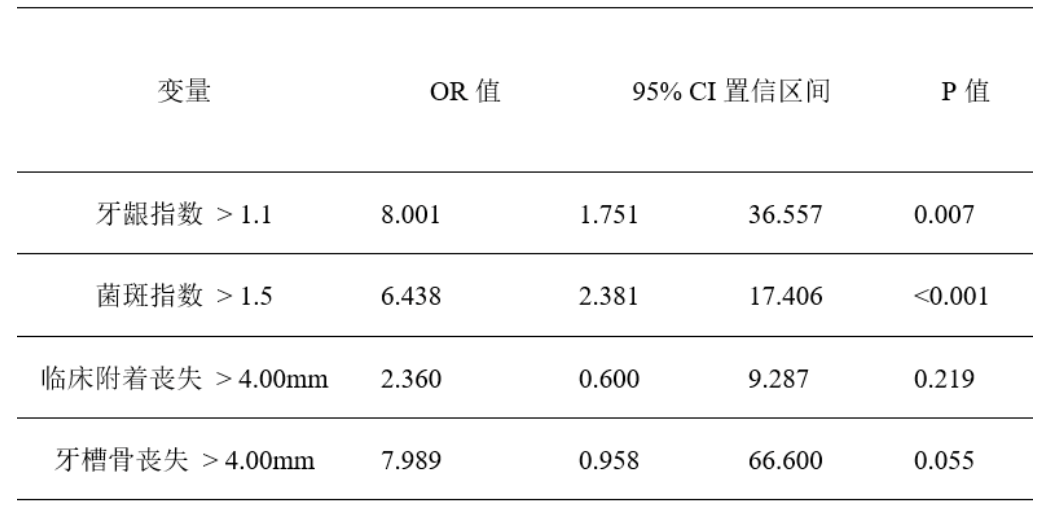
表1 颅内动脉瘤患者临床特点及牙周参数的多因素分析(仅具有统计学意义参数)
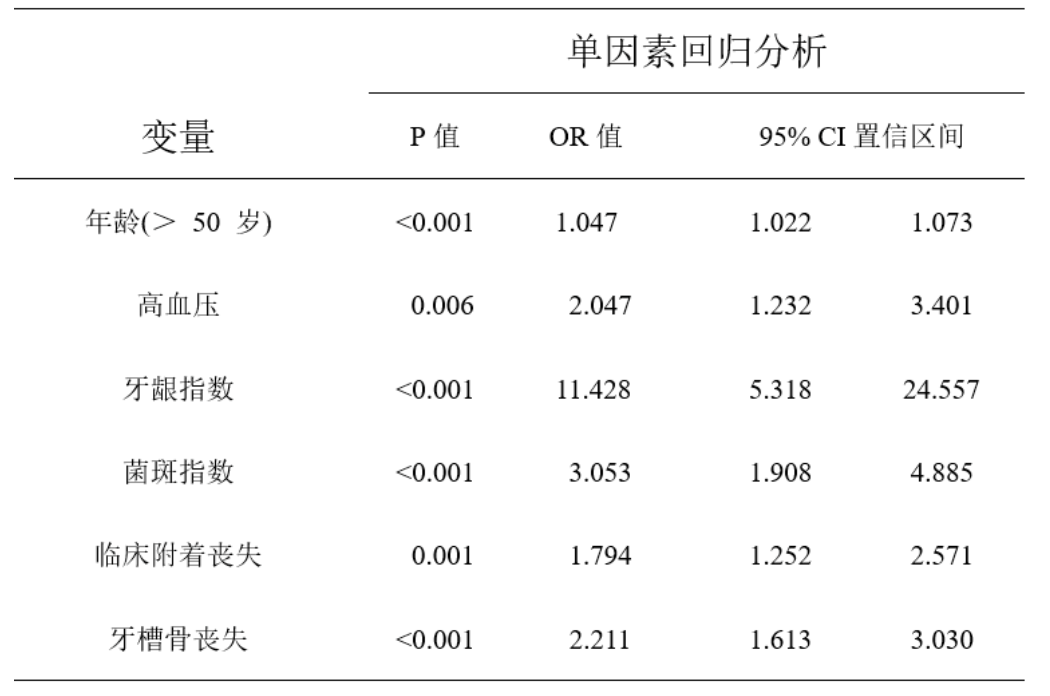
颅内动脉瘤与牙周参数相关性的多因素分析
题目:Correlation of periodontal diseases with intracranial aneurysm formation: novel predictive indicators
作者:Keyun Liu, Jia Sun, Lingling Shao, Hongwei He, Qinglin Liu, Youxiang Li & Huijian Ge
Abstract
Background: We investigated whether periodontal diseases, specifically, periodontitis and gingivitis, could be risk factors of the incidence of intracranial aneurysms (IAs).
Methods: We performed a case–control study to compare the differences in the periodontal disease parameters of 281 cases that were divided into the IAs group and non-IAs group. All cases underwent complete radiographic examination for IAs and examination for periodontal health. Results: Comparing with those in the non-IAs group, the cases in the IAs group were older (53.95 ± 8.56 vs 47.79 ± 12.33, p < 0.001) and had a higher incidence of hypertension (76 vs 34, p = 0.006). Univariate logistic regression analysis revealed that age (> 50 years) and hypertension were predictive risk factors of aneurysm formation (odds ratio [OR] 1.047, 95% confidence interval [95% CI] 1.022–1.073, p < 0.001 and OR 2.047, 95% CI 1.232–3.401, p = 0.006). In addition, univariate and multivariate logistic regression analyses showed that the parameters of periodontal diseases, including gingival index, plaque index, clinical attachment loss, and alveolar bone loss, were significantly associated with the occurrence of IAs (all p < 0.05). For further statistical investigation, the parameters of periodontal diseases were divided into four layers based on the quartered data. Poorer periodontal health condition (especially gingival index > 1.1 and plaque index > 1.5) had the correlation with IAs formation (p = 0.007 and p < 0.001).
Conclusion:Severe gingivitis or periodontitis, combining with hypertension, is significantly associated with the incidence of IAs. Keywords: Gingivitis, Intracranial aneurysms, Inflammation, Periodontitis
原文链接:https://cnjournal.biomedcentral.com/articles/10.1186/s41016-021-00249-x
转载自CNJ | 牙周疾病与颅内动脉瘤发生的相关性分析:一项新的预警指标?